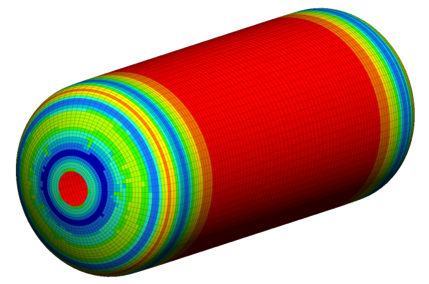
simulation of a hydrogen pressure vessel
Increasing the Efficiency of Damage Modeling for Filament Wound Pressure Vessels through Multiscale Simulation​

2nd of December 2020, 11.00 – 11.30 Uhr
Altair ATCx Composites Online-Conference

The reduction of testing and manufacturing costs is a major challenge in the development of a hydrogen pressure vessel. Therefore, we have created a design process using modern simulation technologies, which offers a significant reduction of risks in the development of composite pressure tanks. Our presentation at the Altair Technology Conference shows how we have combined concept, design, testing and process development into a chain.

Register here: https://web.altair.com/atcx-composites or find further information on the Development of H2-Pressure Vessels here.

Wasserstoffdrucktank

The global aviation industry is undergoing a profound transformation. While aircraft performance and range have been the primary focus in recent years, requirements are increasingly shifting toward industrial scalability and cost efficiency. Modern aviation systems must not only be high-performing and lightweight, but above all economically […]
Compaction Simulation as a Key Enabler for Realistic Composite Materials Structures Composite components are often modelled in structural design using idealized material models. Each ply is assigned a defined thickness, fiber volume content, and orientation. This approach is appropriate in early design phases. However, in highly […]
New Article on Advanced Composites Engineering with CompositesWorld We are pleased to share that CompositesWorld, one of the leading publications in the advanced composites industry, has featured CIKONI in a recent article authored by Ginger Gardiner. The article highlights our integrated approach to engineering, process development, […]

Working with us: Why CIKONI?

  • Experience with CFRP: Our team consists of composite engineering experts with a broad set of experiences in industries, technologies and various domains. From simulation to automation: We did it.
  • Agility: When it comes to speed, our approach is built on an entrepreneurial mindset and a desire to solve your problems in the shortest possible time. Fast iterations and quick learnings are part of our DNA.
  • Realization: We don’t stop at engineering. Transferring our designs and developments to realization is what we thrive for. With our broad network of partner companies we can realize even advanced designs in a reliable manner.