

A personal retrospective by Dr. Farbod Nezami
Looking back at the past years at CIKONI, there are few technology fields that have accompanied our development as consistently as composite tanks and advanced fiber-reinforced storage systems.
By now, the term pressure vessel has almost become too narrow. Our projects range from conventional high-pressure storage systems for gaseous hydrogen to structures exposed to extreme pressure conditions in deep-sea environments and cryogenic tanks for liquid oxygen and liquid hydrogen in aerospace applications. We work on cylindrical tanks, spherical vessels and toroidal geometries, as well as space-adaptive storage concepts. Some structures measure only a few centimeters, others several meters.
Despite the diversity of these applications, they share one fundamental challenge: high-performance composite structures cannot be developed in isolation. Material selection, laminate architecture, manufacturing process, machinery, quality control and simulation are closely interconnected. For me, this is one of the most important lessons from more than ten years of working in this field.
The story began even before CIKONI
The technological roots reach back even further than our foundation in 2015. One of our co-founders had previously worked extensively on novel composite pressure storage systems at the German Aerospace Center, DLR. Unlike conventional cylindrical pressure vessels, the so-called “honeycomb tank” was designed to make significantly better use of the installation space available in a vehicle. The project received several awards.
When we founded CIKONI in 2015, there was therefore already a deep understanding of how closely the development of a composite storage system is linked to the manufacturing process and the structural concept.
We decided early on to develop this expertise systematically.
Our first focus: development methods that reflect the real tank
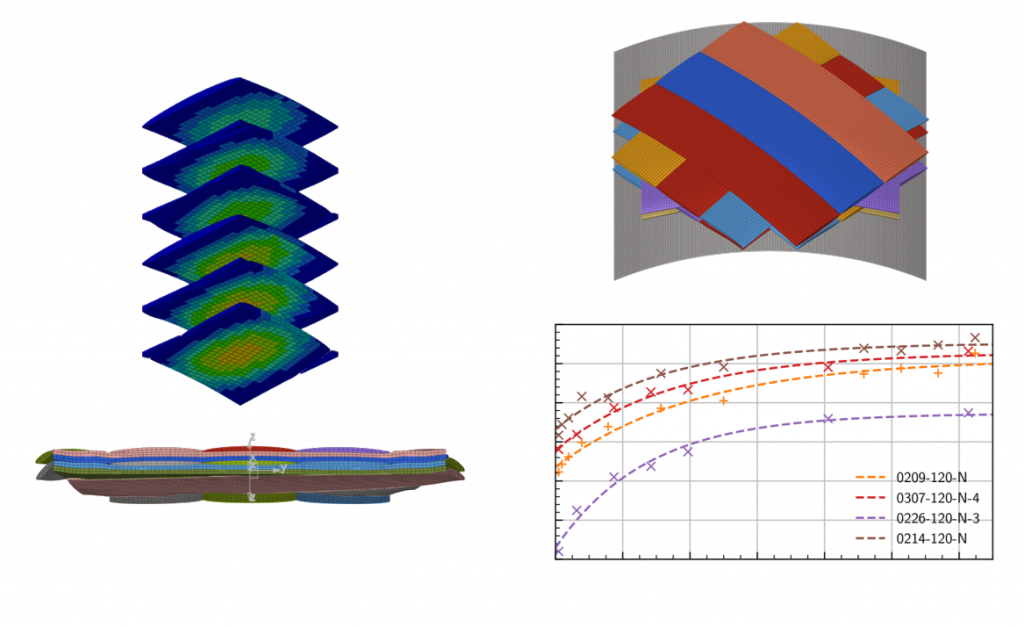
At the beginning, one question was particularly important to us: How can a composite tank be simulated in a way that does not merely represent an idealized structure, but the actual tank that will later come out of the manufacturing process?
Standards, certification requirements and analytical calculation methods naturally form an important basis. However, they are not sufficient for rigorous lightweight and cost optimization.
Composite pressure vessels can be manufactured in very different ways. Filament winding with wet rovings or towpregs is among the established processes. Other concepts combine winding processes with braided preforms, RTM processes or local reinforcement technologies.
Each of these processes creates a specific laminate architecture. This becomes particularly evident in the dome area of filament-wound vessels. Fiber angles, local laminate thickness, deposition patterns, overlaps and compaction all result from the kinematics of the winding process. The actual laminate therefore inevitably deviates from an idealized layered model.
If these effects determine where fiber material is truly required, they must also be reflected in structural simulation.
Over the years, we have therefore developed our own toolchain for transferring manufacturing information from different sources into FE models. This includes data from winding simulations as well as optical 3D measurements. Today, these capabilities are complemented by methods for compaction simulation, material modeling and multiscale simulation.
The objective is not simulation for its own sake. What matters is establishing a reliable link between the manufacturing process and the resulting structural behavior.
Our current development approach for CFRP pressure vessels describes this end-to-end digital process from winding simulation to structural analysis in greater detail: Development of CFRP high-pressure vessels for hydrogen storage at CIKONI
This connection between manufacturing and simulation later became equally important for the next step in our development journey.
Why we started reinforcing pressure vessels locally
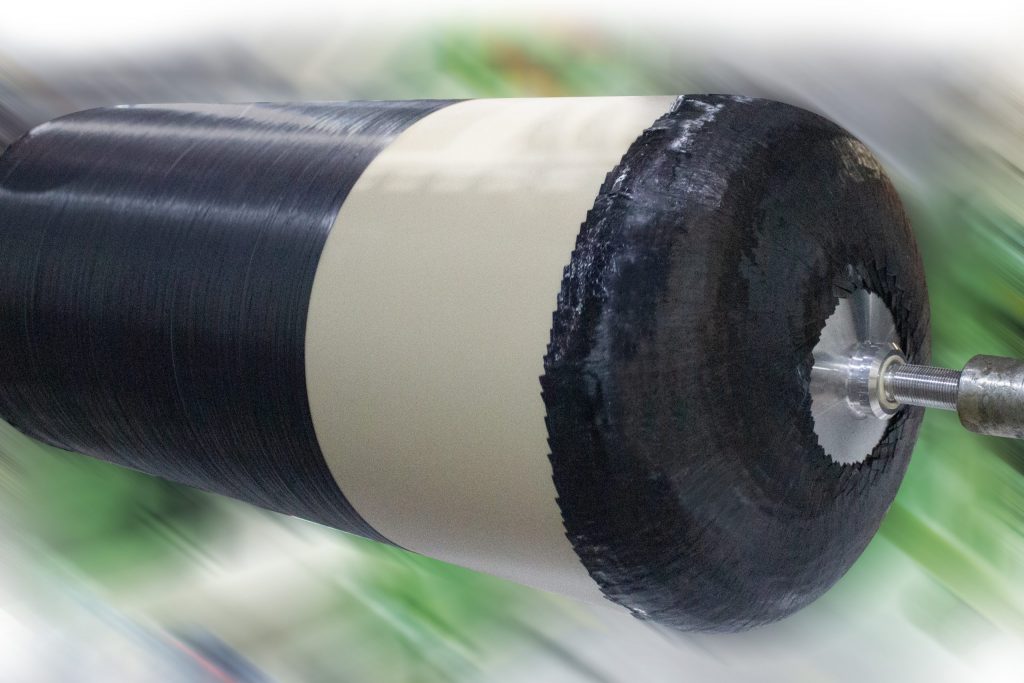
When optimizing filament-wound composite pressure vessels, one eventually encounters a fundamental limitation of the manufacturing process.
In conventional filament winding, a continuous roving is guided around the tank. By coordinating the rotation of the component with the movement of the fiber delivery system, fiber angles can be controlled very precisely. What is far more difficult, however, is truly local material deposition.
A fiber does not simply start at a highly loaded area and stop immediately after that region. It continues around the component.
For conventional composite lightweight design, this is unusual. In many other composite structures, local patches, reinforcements and deliberately introduced thickness transitions are standard design tools. Material is placed where the loads require it.
In filament winding, this kind of local adaptation is difficult.
This becomes particularly relevant at the transition between the cylindrical section and the dome. To reinforce the dome sufficiently, winding layers are required that simultaneously add material to regions of the vessel where, from a structural perspective, some of that material is not actually needed.
The logical question for us was therefore: Why should we accept this limitation as a given?
Together with partners, we began developing local reinforcement concepts for the dome area. This created two challenges at the same time. On the one hand, we needed to establish an industrially viable manufacturing technology for integrating local reinforcements. On the other hand, we needed simulation and design methods that would allow these reinforcements to be dimensioned reliably and coupled with the subsequently wound laminate.
Together with Cevotec and Roth Composite Machinery, we were eventually able to implement and experimentally validate this concept on an industrial composite pressure vessel.
The results were significant: in the demonstrated tank concept, fiber material usage was reduced by 15 percent. At the same time, storage efficiency increased by 17 percent, while maintaining comparable mechanical performance.
For this joint development, Cevotec, Roth Composite Machinery and CIKONI received the CAMX Combined Strength Award in 2024. CAMX specifically recognized the Composite Tank Dome Reinforcements developed within the joint industrial project. JEC also highlighted the approach of local dome reinforcement and its potential to reduce carbon fiber consumption: JEC: Enabling superior storage efficiency for Type 4 tanks with FPP dome reinforcements
For me, however, the award itself is less important than the technological consequence.
We are convinced that the next generation of cost-optimized composite pressure vessels will make far more systematic use of local reinforcement concepts. Carbon fiber represents a substantial share of the cost of a high-pressure storage system. If material can be removed specifically from regions where it contributes little structurally, this changes more than just the weight of the tank. It changes the economics of the entire storage system.
Of course, this also introduces additional process steps, investment in production equipment and higher requirements for engineering and design. From our perspective, however, these efforts are offset by considerable potential in terms of material usage, storage efficiency and cycle time.
The key question is therefore no longer fundamentally whether local reinforcement works. The more interesting challenge today is how to optimize it for specific tank architectures, production volumes and manufacturing systems.
FEA alone is not enough: our path into robotic manufacturing
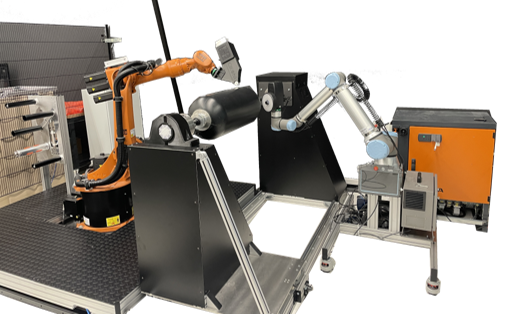
In parallel with this work, it became increasingly clear to us that even a powerful simulation environment is not enough.
In many development projects, design variants need to be manufactured and tested quickly. A winding angle may need to be adjusted, a different material system processed, or a new liner geometry investigated. In such situations, maximum production speed is not the key parameter.
Flexibility is.
That is why we began developing our own winding systems as early as 2018.
Rather than relying exclusively on conventional production machinery, we developed both the hardware and software ourselves. This allows our engineers to adapt the systems to the specific development task, integrate new process modules and realize even unconventional winding applications.
Today, this expertise ranges from CFRP creels, resin baths and fiber guidance systems to multi-axis robotic fiber application units. Upstream and downstream process steps can also be integrated into the manufacturing environment.
We can process wet-winding systems as well as towpregs and use different reinforcement fibers.
The result is not a production line optimized for maximum series throughput, but a highly flexible R&D environment.
For our development work, that is exactly what matters: we can formulate a hypothesis in simulation, adapt the manufacturing process accordingly, produce a demonstrator, measure it and feed the results back into the model.
This closes a loop that we already considered essential in our earliest work on composite tanks.
Quality is not an end-of-line inspection task
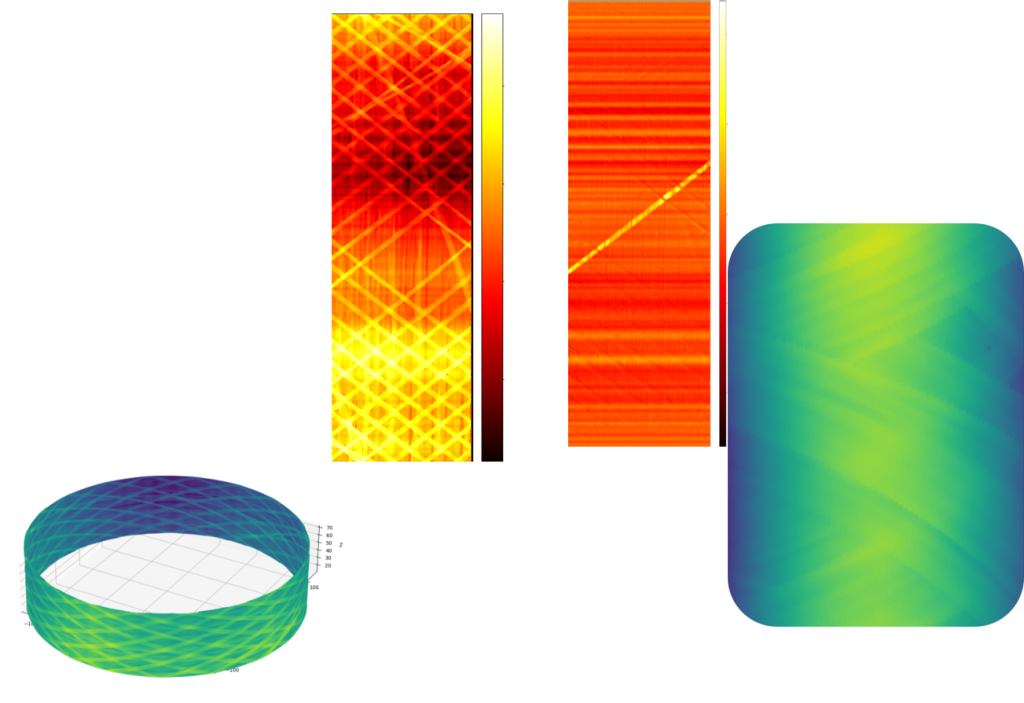
Anyone who works with filament-wound composite structures for a longer period of time eventually realizes that another factor is at least as important as a good nominal design: process stability.
A composite tank is only as good as the laminate that is actually produced on the component.
Fiber orientations can deviate from their target values. Tows can shift, gaps can occur and overlaps can form. In wet winding, fluctuations in resin uptake affect the fiber volume fraction and therefore both the weight and the mechanical properties of the laminate.
For this reason, we began to address quality not only after the component had been completed, but while it was being manufactured.
Our optical DrapeWatch system, originally developed for planar composite structures, was adapted to winding processes and further developed into a process-monitoring solution for filament-wound components. Today, the technology monitors parameters including fiber orientations, tow positions and deposition deviations during the process.
Within our current toolchain, we refer to this approach as TowSight – a system for automated quality control of tow placement.
The second key parameter is resin uptake.
In wet winding processes, resin uptake is a major factor determining the resulting fiber volume fraction. Excess resin increases weight and material consumption without providing corresponding structural benefit. Insufficient resin, on the other hand, can lead to inadequate impregnation, porosity and significant quality issues.
With our patented in-process technology ResInspect, we therefore measure resin uptake continuously during the winding process.
From our perspective, this creates two particularly interesting opportunities:
- The first is obvious: existing and new winding systems can be upgraded with continuous quality assurance.
- The second is perhaps even more relevant for development: real process data can be fed back into our simulation models.
If we measure local fiber angles, laminate thicknesses or fiber volume fraction gradients and combine these data with compaction and structural simulations, we can gradually create a much more realistic digital representation of the manufactured component.
This combination of multidisciplinary simulation and real-time process monitoring has also been featured by CompositesWorld: CIKONI: Pushing the boundaries of lightweight design
For me, this is one of the most interesting developments for the coming years: quality assurance is evolving from a downstream inspection task into an integral part of development, process control and the digital representation of the component.
From hydrogen pressure vessels to composite storage systems
These methods are no longer limited to conventional high-pressure hydrogen tanks.
That is precisely what makes this technology field so interesting to us.
We are currently working, for example, on structures for deep-sea applications, where several challenges occur simultaneously: pressures at water depths of several thousand meters, combined internal and external pressure loads, low temperatures and permanent exposure to salt water.
At the other end of the application spectrum are aerospace applications.
For a European space company, for example, we are developing an ultra-lightweight, linerless tank for cryogenic liquid oxygen, LOX. Here, extreme lightweight requirements meet very low temperatures, thermomechanical loads and the specific challenges associated with a highly reactive oxidizer.
In another development environment, we are working together with a German aircraft manufacturer on liquid hydrogen, LH2.
This fundamentally changes the engineering challenge.
A 700-bar hydrogen tank involves a different combination of load cases, permeation behavior, material selection and manufacturing requirements than a cryogenic liquid storage system. The underlying engineering philosophy, however, remains the same:
We need to consider material, structure, process, quality, business objectives and system requirements together.
Geometrically, too, the world does not end with the cylindrical tank.
At CIKONI, we have now developed cylindrical storage vessels as well as spherical and toroidal tanks. And sometimes the story comes full circle: space-adaptive, approximately box-shaped pressure storage systems continue to play a role as well.
What we take away from ten years of composite tank development
If I had to reduce our development in this field to one key insight, it would be this:
The next generation of composite storage systems will not be determined by a single technology.
- Better FEA alone is not enough.
- A faster winding machine alone is not enough.
- A new reinforcement process alone is not enough.
- And additional sensors alone do not turn a process into a robust industrial manufacturing system.
The real potential emerges where these disciplines are connected.
That is why, over the years, we at CIKONI have built not only expertise in the product development of composite tanks. We develop simulation and software methods, design and build manufacturing equipment, develop automation solutions and integrate quality technologies.
Our objective is to create a development perspective that is as holistic as possible while remaining tailored to the individual requirements of each customer.
Our more detailed assessment of the different levers for reducing the cost of composite pressure vessels shows just how closely these topics are now interconnected: Strategies for reducing cost in the design and manufacturing of composite pressure vessels
At the same time, we know that no one develops complex high technology alone.
An essential part of our work is therefore the international network of specialized material suppliers, machinery manufacturers, technology companies, research partners and testing facilities with whom we have worked successfully and with great appreciation for many years.
Projects such as the joint development of local dome reinforcement with Cevotec and Roth Composite Machinery demonstrate very clearly, in my view, what becomes possible through this kind of collaboration.
We see our role in bringing these capabilities together with our own development tools, manufacturing infrastructure and, above all, the engineers at CIKONI.
From a few centimeters to several meters.
From spherical to space-adaptive geometries.
From high pressure to cryogenics.
And by now, quite literally, from several thousand meters below the sea surface to space.
We look forward to continuing this journey together with ambitious technology companies and contributing wherever established solutions reach their limits.
Please feel free to contact us: CIKONI composites innovation – Stuttgart, Germany.

