
Compaction Simulation as a Key Enabler for Realistic Composite Materials Structures
Composite components are often modelled in structural design using idealized material models. Each ply is assigned a defined thickness, fiber volume content, and orientation. This approach is appropriate in early design phases. However, in highly loaded Lightweight Engineering structures, the manufacturing process ultimately determines the laminate state that is actually created – and the structural properties that result from it.
During layer-by-layer manufacturing, fibers are tensioned, guided over flat or curved geometries, and compacted again by subsequently deposited layers. As a result, the roving cross-section, ply thickness, and fiber volume content change. This compaction determines the local fiber content within the Composite Materials system and, consequently, the properties of the resulting laminate.
CIKONI has developed and validated a novel process-oriented approach for considering compaction-dependent mechanical properties by combining experimental characterization with numerical CFRP simulation. The objective is not to explain individual manufacturing effects retrospectively, but to improve understanding of the laminate state during digital development. This enables a higher level of lightweight performance and a more reliable basis for Carbon Fiber Component Engineering.
Why Compaction Matters in CFRP Design
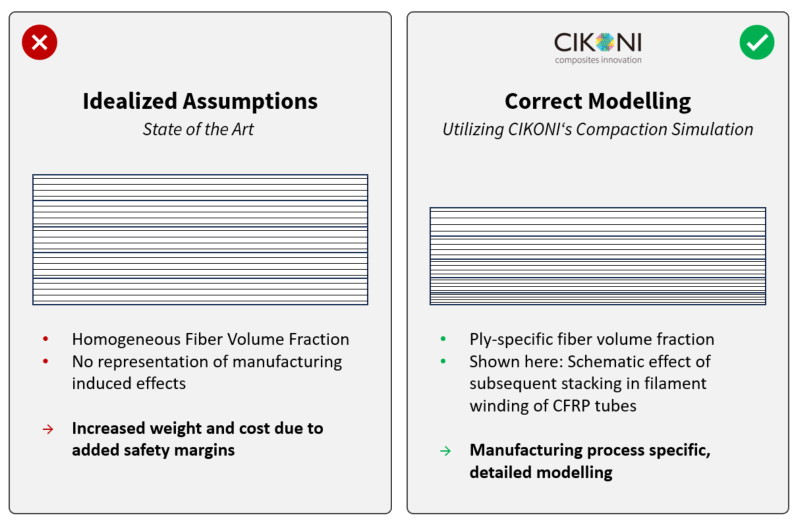
Fiber volume content has a direct influence on stiffness, strength, and other key parameters of component quality. The actual ply thickness affects laminate geometry, stress distribution, and mass. If these values are assumed globally or idealized too early, uncertainty is introduced into the structural assessment.
The investigations show that the compaction state depends on many influencing factors, particularly the normal and axial stresses acting on the roving, deposition angle, curvature, material state, and stacking sequence. In filament winding, for example, inner layers are further compacted by subsequently deposited layers. Outer layers are exposed to different boundary conditions. The final laminate state is therefore not homogeneous through the thickness – it is process-dependent.
This is directly relevant for Lightweight Engineering. Without considering compaction and local laminate properties, safety margins may be misjudged or components may be designed with unnecessary conservatism. A digital model, by contrast, enables more realistic local laminate properties to be derived from the manufacturing process. This allows the material to be used more precisely, reducing not only weight but also material costs.
From Carbon Fiber Roving to Local Unit Cells
The foundation is a dedicated experimental methodology for characterizing individual rovings under defined boundary conditions. Rovings are guided over a curved surface under axial pre-tension and then measured. From the measurement data, cross-sectional area, width, effective thickness, and fiber volume content can be derived.
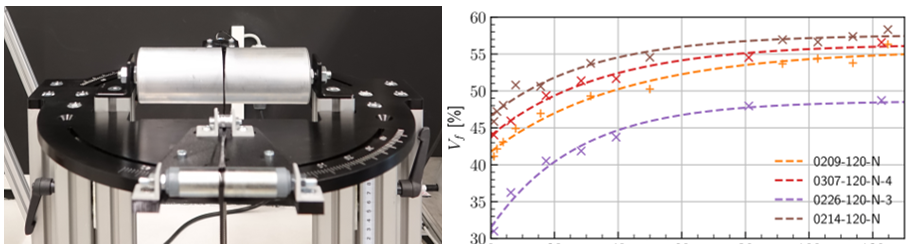
Figure 1: Measurement of compaction effects on individual rovings
These data are used to calibrate a numerical model. The goal is not to reproduce every microscopic detail, but to establish a robust and efficient description of the relevant compaction effects. The model is then transferred to a unit cell of a multi-layer laminate. This enables efficient comparison of the effects of stacking sequence, orientation, and pre-tension on the compaction state.
Key Findings
The simulations and experiments show that compaction in multi-layer laminates is distributed highly non-uniformly. Plies that are nominally identical may exhibit different thicknesses and fiber volume contents after manufacturing. The through-thickness profile is particularly informative, as it reveals the process history of each individual layer.
A laminate is therefore not simply a stack of idealized single plies. It is the result of mechanical interaction between roving, tension, curvature, and previously deposited layers. This interaction determines local properties that are highly relevant for subsequent structural assessments and CFRP Simulation.
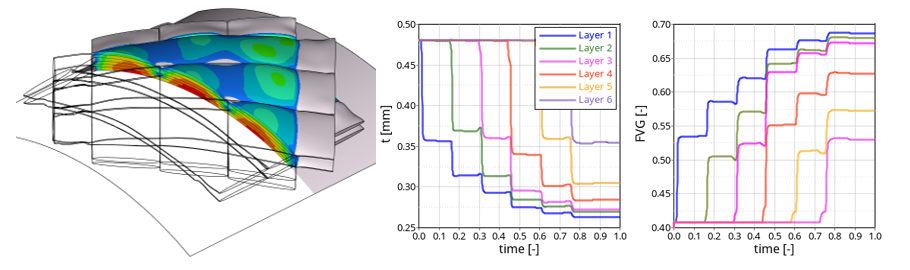
Figure 2: Ply thickness and fiber volume content in a multi-layer laminate
Benefits for Composite Lightweight Design
An obvious application field is CFRP wound pressure vessels, especially Type 4 and Type 5 pressure tanks designed for high pressures and therefore large wall thicknesses. However, the method is relevant beyond this use case, including other winding or braiding CFRP components such as hollow profiles, local reinforcements, and complex lightweight structures with multi-layer laminate architectures.
The benefit is particularly significant where conventional calculation models simplify too early. Process-oriented models reduce uncertainty between manufacturing and simulation. They support a more realistic evaluation of virtual prototypes, more targeted material utilization, and a closer exploitation of lightweight potential within the boundaries of real manufacturability.
Especially in the development of novel composite processes, it is often not sufficient to apply existing simulation routines. What is required is the ability to tailor test methods, modeling approaches, and evaluation strategies to the specific technical question – and to develop new methods where necessary. This combination of testing, simulation, and application-oriented interpretation is where the real development leverage emerges – and where CIKONI’s core expertise lies.
Conclusion
Compaction affects ply thickness, fiber volume content, and local component properties. A process-oriented compaction simulation makes these effects visible and supports more realistic development of fiber-reinforced composite structures.
The approach demonstrates how complex manufacturing effects can be transferred into reliable digital models. It creates a link between process understanding and structural assessment, which is becoming increasingly important for advanced Composite Materials development.
At CIKONI, we provide deep engineering expertise in lightweight design and composite materials. We deliver end-to-end solutions for mission-critical application fields. From concept development and component engineering through to industrialization, we are your partner for demanding lightweight projects.

